
One of the most common questions we get is: how much does it cost to run a workflow?
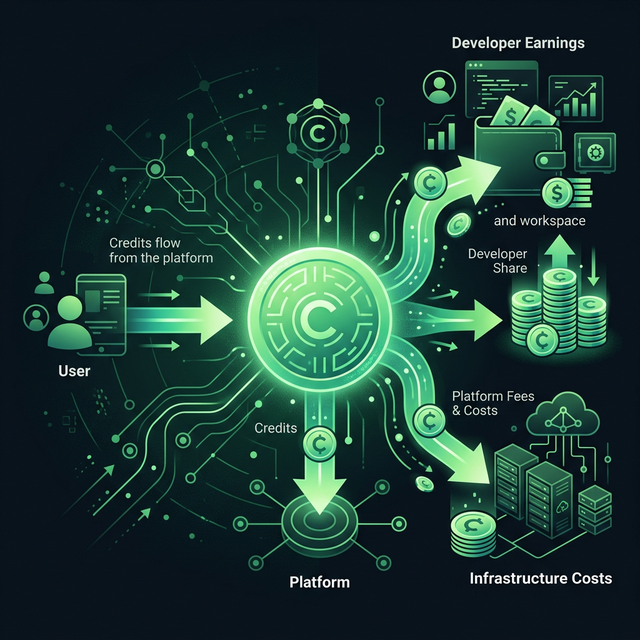
The answer is refreshingly simple. Lyzn uses a unified credit system that makes pricing transparent, per-use charges predictable, and developer earnings completely fair. No hidden fees, no surprise bills.
The Credit System
Everything in Lyzn runs on credits. One credit equals ₹0.1 — a simple, fixed conversion rate.
You can get credits in two ways:
- Subscription plans — Monthly plans that include a bundle of credits, renewed each billing cycle
- Pay-as-you-go — Purchase credit packs anytime. These never expire and are consumed only when you run workflows
Free monthly credits reset at the start of each billing cycle. Purchased credits stick around until you use them.
What Does a Workflow Cost?
Every time a workflow runs, the total cost is the sum of two components:
1. Operational Cost (goes to Lyzn)
This covers the infrastructure and resources needed to execute the workflow — CPU time, API calls, LLM tokens, and more. Lyzn uses this to maintain the platform, pay for third-party API usage, and keep the lights on.
Different nodes have different pricing models:
| Pricing Type | How It Works | Example |
|---|---|---|
| Fixed | A flat credit cost per execution | HTTP Request node: 0.5 credits |
| Dynamic | Cost scales with actual usage | AI Agent node: charged per token used |
| Time-based | Charged per second of execution | Delay or heavy computation nodes |
| Free | No operational cost | Variable assignment, logic gates |
2. Workflow Cost (goes to the developer)
This is a creator fee set by the workflow builder. When someone publishes a workflow to the marketplace, they can set a price — say, 10 credits per run. 100% of this fee goes directly to the developer. Lyzn takes zero cut from the workflow cost.
So the total formula is:
Total Cost = Operational Cost + Workflow Cost
If a builder sets their workflow price to 0, users only pay the operational cost — the bare minimum to run reliable infrastructure.
A Real Example
Imagine a workflow that summarizes a daily news feed using AI:
| Step | Type | Cost |
|---|---|---|
| Node 1: HTTP GET (fetch news) | Fixed | 0.5 credits |
| Node 2: AI Summarize | Dynamic (tokens) | ~2.0 credits |
| Builder Fee | Workflow Cost | 5.0 credits |
| Total | 7.5 credits |
The user pays 7.5 credits. The developer earns 5.0 credits. Lyzn receives 2.5 credits to cover infrastructure.
Who Gets Charged?
The executor — the person who runs the workflow — always pays. This applies universally:
- End users running published workflows from the marketplace? They pay.
- Developers testing their own workflows? They pay too.
This keeps the system honest. When a developer is building and testing, they experience the same cost structure their users will. No free passes means developers are incentivized to build efficient workflows.
The Marketplace Economy
LyznFlow has a built-in marketplace where developers can publish their workflows for others to use. This creates a two-sided economy:
For Developers (Builders)
You set a Workflow Price in the workflow settings panel. This is a fixed credit fee charged to anyone who runs your workflow, and you keep 100% of it.
| Your Price Setting | User Pays | You Earn |
|---|---|---|
| 0 credits (Free) | Operational cost only | 0 credits |
| 10 credits | Operational + 10 credits | 10 credits |
| 50 credits | Operational + 50 credits | 50 credits |
Your earned credits accumulate in your Developer Balance. These credits can be used to run other workflows yourself — creating a circular economy where active builders can sustain their usage through earnings.
Coming soon: Credit withdrawals. We’re building out the payout system so developers can convert earned credits to real currency through the Lyzn Partner Program.
Private vs Published
Not every workflow needs to be public. You can:
- Keep it private — Use the workflow yourself, pay for what you use. Nobody else can see or run it.
- Publish to marketplace — Set a price, earn credits when others run it. Build passive income from your automation expertise.
Subscription Plans
Developers can also create subscription plans for their workflows. Instead of charging per run, they can offer bundled access:
- Run Quota — “50 runs included”
- Validity Period — “Valid for 30 days”
- Free Tiers — Offer a limited free plan to attract users
Users subscribe, get a quota of runs, and don’t worry about per-execution costs during the subscription period. Operational costs are still covered, but the subscription replaces the per-run workflow fee.
This is particularly useful for workflows that users run repeatedly — like daily social media schedulers, report generators, or monitoring tools.
How Lyzn Earns
Let’s be transparent about the business model:
- Operational margins — The operational cost covers infrastructure (servers, databases, AI model API calls) with a small margin for platform sustainability
- Subscription revenue — Users buying credit packs or monthly plans
- No take rate on developer earnings — Lyzn does not take a percentage of what developers earn. If a developer sets a 50-credit workflow price, they get all 50 credits.
This alignment means Lyzn succeeds when the ecosystem succeeds. More developers building valuable workflows → more users running them → more operational revenue for the platform → everyone wins.
Developer Dashboard
Every developer gets a real-time dashboard to track:
- Total Runs — How many times your workflows have been executed
- Total Earnings — Cumulative credits earned across all workflows
- Per-Workflow Analytics — Which workflows are performing, who’s using them, and optimization opportunities
Insufficient Credits?
If a user doesn’t have enough credits, the workflow simply won’t start. No partial execution, no surprise charges, no debt. The system checks your balance upfront and won’t deduct until the execution completes successfully.
The Philosophy
We designed Lyzn’s pricing around three principles:
- Pay for what you use — No idle charges, no minimum commitments
- Fair developer compensation — 100% of workflow fees go to builders
- Transparent costs — Every credit deduction is logged, traceable, and explainable
AI automation shouldn’t be a black box — not in how it works, and not in how it’s priced.
Ready to build and earn? Start at flow.lyzn.ai.